

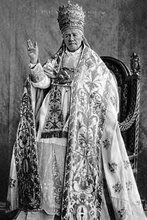

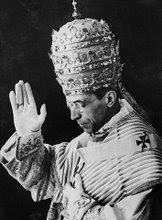


PIUS X AND CARDINAL PIE (From The Angelus, May 2004)
Pope Pius X never hid his admiration for Cardinal Pie, who was probably the greatest French bishop of the 19th century. The posthumous influence that he was to exercise on Pius X does even more credit to his teaching. On March 1, 1912, he gratified the cathedral of Poitiers with the title of minor basilica, a tribute which revealed what was in his heart, as Canon Etienne Catta remarks in his book The Social and Political Doctrine of Cardinal Pie.2 To Cardinal Pie, Pope Pius X rendered homage that day when he referred to St. Hilary, Doctor of the Church, "the intrepid champion of the divinity of Christ against the Arians, but alongside of him it is sweet to remember Louis-Edouard Pie, cardinal of the Holy Roman Church, who, like a second Hilary - alter Hilarius - avenged the integrity of the Faith against the modern Arians by his victorious eloquence."3
Canon Vigue recounts in the introduction to his Selected Writings of Cardinal Pie4 that one day a priest from the diocese of Poitiers had the honor of being received into the office of Pope Pius X.
"Oh! The diocese of Cardinal Pie," said the Holy Father, raising his arms as soon as he had heard the name of Poitiers. "I have the works of your cardinal right here, and for years hardly a day has gone by that I haven't read a few pages."
As he spoke, he took one of the volumes and put it in the hands of his visitors. These could tell, by the wear on the binding, that they must have belonged to the parish priest of Salzano or the spiritual director of the seminary of Treviso long before entering the Vatican.
"As soon as I can snatch a few moments," admitted Pius X on another occasion, "I read something by your great cardinal, Cardinal Pie. He is my mentor."5
Pope Pius X was imbued with the writings of the Bishop of Poitiers and many times, in his pontifical acts, the Pope was to cite him without giving his name. The four examples that follow will try to prove this fact: I) The famous "prophecy" concerning France's future; II) The first pages of his first encyclical, E Supremi Apostolatus; III) The prayer of Pope Pius X to the Immaculate Conception; IV) A final example; V) Conclusion.
"Prophecy for France"
This "prophecy" of Pope Pius X has been published often.6 It was pronounced November 29, 1911, during the allocution Vi Ringrazio, which was a response to Cardinal Falconio, after the creation of several new cardinals, among whom were numbered three Frenchmen distinguished in the battle against modernism: Cardinals Cabrieres, Dubillard, and Billot. The Pope's discourse was not an improvisation; it had been written out by the Pope beforehand. Cardinal Merry del Val testified to the fact before the bishop of Laval during an audience; the latter referred to it in his Religious Week [Semaine Religieuse], July 29, 1917. The letter itself, if not its spirit, had been drawn from the works of Cardinal Pie. Some support for this claim is found in Cardinal Pie's homily when he took possession of his titular see of Santa Maria della Vittoria, in Rome (Sept. 28, 1879)-the very homily printed in the last volume of his episcopal writings7 (Vol. X, pp.63-64).
The thought of Cardinal Pie, which became a "prophecy" in the mouth of St. Pius X, was present in his mind when a parish priest, then bishop, and at last a cardinal, that is to say, during his entire life. This is proven by his sermon "On the Duty of Society as a Whole to Turn Itself Toward God" which he gave in the cathedral of Chartres (Mar. 1, 1846) and the funeral sermon for General de La Moriciere, delivered in the cathedral of Poitiers (Dec. 5, 1865) and published in the episcopal works Oeuvres de Monseigneur I'eveque de Poitiers. It is probably from here that Pius X drew his "prophetic inspiration."
What follows is the text of Cardinal Pie which was known to Pope Pius X, with his "prophecy" after it; then the main passages of Pius X's first encyclical, after passages of Cardinal Pie's first pastoral letter which are most likely their origin. Finally, we reprint Pope Pius X's prayer to the Immaculate Virgin which reads very much like its probable source, Cardinal Pie's prayer to the Immaculate Virgin.
Comparison of the Texts
I
The "Prophecy" concerning France
This "prophecy" of Pope Pius X had been formulated a second time by Cardinal Pie (Dec. 5, 1864). It is clearly from this text that the Pope drew his inspiration.
Cardinal Pie
Text of Card. Pie (Dec. 5, 1864)8
God holds in his hands the hearts of peoples as well as the hearts of men. Courage, O France: thus you will return to your first vocation. Precious instincts, which yet escape you, but which are only asleep, will awaken in your breast.
And even as, like Saul, still breathing threats and slaughter on the road to Damascus, you seem perhaps to be engaged in the way of impiety and violence, suddenly a secret force will throw you to the ground, a blinding light will shine about you, and a voice will be heard: "Who art thou?" you will cry: "Quis es, Domine?' "I am Jesus, whom you pursue, whom you persecute: Ego sum Jesus quern tu persequeris." O France, it is hard for you to kick against the goad. To make war on God is not in your nature. Rise up, predestined race, vessel of election, and go, as in the past, carry my name to all peoples and to all the kings of the earth.
Pope St. Pius X
The allocution Vi Ringrazio (Nov. 29, 1911)9
What shall I say to you now, dear sons of France, who groan beneath the weight of persecution? The people who made an alliance with God at the baptismal font of Rheims will repent and return to its first vocation. Her faults will not remain unpunished, but she will never perish, the daughter of so many merits, so many sighs, and so many tears.
A day will come, and we hope it will not be far, when France, like Saul on the road to Damascus, will be surrounded by a heavenly light and will hear a voice repeating to her, "My daughter, why do you persecute me?" And to her response, "Who art thou, Lord?" the voice will reply, "I am Jesus, whom you persecute. It is hard for you to kick against the goad, because, in your obstinacy, you destroy yourself." And she, trembling and astonished, will say, "Lord, what wouldst thou have me do?" And He will say, "Rise up, wash the filth that has disfigured you, awaken in your heart those dormant affections and the pact of our alliance and go, eldest daughter of the Church, predestined nation, vessel of election, go, as in the past, and carry my name before all peoples and before the kings of the earth."
II
The First Pastoral Letter of Card. Pie
and the First Encyclical of Pope Pius X
Cardinal Pie
The first Pastoral Letter (Nov. 25, 1849)10
It is not for us to say with what pleading and with what tears we have asked that this chalice pass far from us...; but in submitting to a will stronger than our own, we have accepted a heavy charge, a labor of courage and sacrifice. For we are not so blind to the nature of things as to be dazzled by certain outer appearances. We cannot mistake the fact that human society is prey to an evil more intimate, more profound, and more destructive than can be expressed in words.
The logic of passions, long held in check, retained in its advance, has finally produced the inevitable conclusions of the principles posed by the previous centuries. We live in the fatal period of consequences, of extreme consequences. Each day the last hopes melt away; the same terrible problems, pushed aside for a moment, present themselves before us. Any human solution is henceforth impossible. There remains only one alternative: submit ourselves to God, or perish.
If you ask me at this moment who we are, to what party we belong, I will answer without hesitation. We are, and we will be among you the man of God. We will always be of the party of God. We will engage all of our efforts, and consecrate our entire life, to the service of the divine cause. And if we were to adopt one rule of action, it would be this: "Instaurare omnia in Christ" "To restore all things in Christ" (Eph. 1:10).
...What essentially characterizes the modern age is that the world has now been separated into two parties, along a clearer dividing-line and according to a more frank opposition than at any other age, that is, the party of God, and the party of man, or if you prefer, of the prideful genius that drives him. The struggle between man and God had never been more open or more direct. No other generation had broken its every pact with heaven, or so absolutely. No society had ever spoken to God with such resolution or audacity, telling Him: "Begone!" Man had never set himself up as a god on earth with greater insolence. He thought he had already vanquished. The old dream of human pride was thus to become a reality: man was to be his own god.
One could easily have believed that the son of perdition, announced by St. Paul, had appeared on the earth, or at least that all the elements he was to embody awaited only their unification in a single person to constitute the Antichrist named by the Scriptures. Vowed to the most constant opposition, adversary of all belief and of any affirmation of truth, man had also toppled all that bore the character of the divinity, or any resemblance thereof. And if the idea of a god still remained, it was because man, putting himself at the place of his Creator, had made the universe into a temple, in which he played the god.
The struggle was unequal, and we knew which side would carry off the victory and which know defeat. The more man seemed to triumph, the more surely we predicted his fall, and, to speak as do the holy books, one of those catastrophes whose blast long echoes in the ears of those who hear.
History had taught us that God hides Himself for a certain time, and that He seems at times to retreat before His enemies, but that these apparent defeats are of the moment, and are only the wise and cunning tactics of Providence, after which He takes back the position and delivers the final blow. More than once it seemed to us that the heavenly spirits, weary of the long success of the triumphant rebellion, adopted the language of the prophets and said, "Arise, O God, and may it not be given to man to prevail."
That is why, notwithstanding the great work of social reconstruction undertaken by so many architects at once, we will suffer in spite of ourselves the consequences of the sins of our fathers, so long as we have not rebuilt, in the heart of the nation, the temple they overturned. Men speak of a great party founded in the name of order and compromise. Only one party can save the world, the party of God. There alone is salvation. Renounce our dreams of independence from the Supreme Being, and submit to Him. Make no mistake. The burning question, and the question that troubles the world, is not between man and man; it is between man and God. If we were to adopt a single rule of action, it would be "to re-establish all things in Jesus Christ." Jesus Christ! Ah! We are profoundly moved as we utter this sacred name among you for the first time, this saving name that we will have so often to repeat. "For other foundation no man can lay, but that which is laid by the hand of God; which is Christ Jesus" (I Cor. 3:11).
The God whose minister-whose ambassador-we shall be among you is not that vague, complacent God whose tutelary authority is invoked by today's materialism, taking fright and wishing to defend its pleasures and its idols against the new wave of invaders, firmly resolved to pay Him no tribute in return, and certainly not to offer Him any sacrifice. Our God is He who gave His law to men, who came down to earth and who spoke in the person of Jesus Christ, His Son and His envoy. Outside of Jesus Christ, there is no other Messias, or Revelation, or Savior.
Both God and Jesus Christ are to be found by us only in the Catholic Church. Whoever does not listen to the Church, is in our eyes worse than an infidel.
Therefore, to replace all these things under the legitimate empire of God, of Jesus Christ, and of the Church; everywhere combat that sacrilege which puts man in the place of God, and which is the chief crime of the modern age; resolve anew, by the precepts or the counsels of the Gospel and by the institutions of the Church, all the problems that the Gospel and the Church had already resolved-education, family, property, power; to re-establish a Catholic balance between the diverse conditions within society; to pacify the earth and give citizens to heaven: such is our mission.
L.E. Pie
Pope St. Pius X
The first encyclical E Supremi Apostolatus (Oct. 4, 1903)11
I need not remind you with what tears and ardent prayers we endeavored to turn aside the heavy charge of the supreme pontificate. Fully conscious of our weakness, we dreaded to take on a work so replete with difficulty, and yet so imperative.
We felt a kind of terror when we called to mind the tragic condition of humanity today. Can anyone be unaware of the profound and serious illness from which human society suffers, now so much more than in the past, and which, worsening day by day and eating away at its very substance, drags it down to ruin? This illness, as you well know, is apostasy and the rejection of God; and surely there is nothing that leads more inevitably to disaster, according to the word of the prophet, "Behold, those who depart far from you will perish."
We declare in all truth that we desire to be, in the midst of human societies, nothing other than the minister of that God who has invested us with His authority, and with the divine assistance, we shall be only that. His interests remain our interests; to consecrate our strength and our life to them: such is our unshakable resolution. That is why, if one asks us for a motto revealing the very depths of our soul, we will give none but this: "To restore all things in Christ."
...in the face of the impious war that has been declared and that continues to be waged against God from nearly every side. In our day it is only too true, "the nations have trembled and the peoples have meditated folly" against their Creator, and this cry has become nearly a commonplace among His enemies: "Depart from us." From there springs, from nearly every side, a total rejection of any respect for God. From there spring those manners of living, public as well as private, without the least regard for His sovereignty. What is more, there is no effort and no artifice that is not employed in the attempt to abolish the memory of Him, and even the very notion of God.
He who considers these things may well fear that such a perversion of mind be the beginning of those evils announced for the end of time and as it were their introduction upon the earth, and that truly the son of perdition of whom the Apostle speaks (II Thess. 2:2) is already among us. So great is the boldness and so violent the rage with which men everywhere hurl themselves to the assault of religion, attack the dogmas of the Faith, and labor with obstinacy to destroy all relation of man to the divinity! On the other hand, and this is the hallmark of the Antichrist, in the very words of the same Apostle, man, with an unspeakable temerity, has usurped the throne of the Creator, raising himself above all that bears the name of God. And this to such a degree that, powerless to eradicate in himself the notion of God, he nonetheless shakes off the yoke of His majesty and dedicates the temple of the visible world to himself, where he wishes to receive the adoration of his fellow creatures. "He is enthroned in the temple of God, where he presides as if he himself were God."
No sane mind can doubt what will be the outcome of this war waged on God by frail mortals. Man is surely able to abuse his liberty if he wishes and violate the rights and the supreme authority of the Creator, but the victory will always belong to the Creator. But my words fall short. Catastrophe threatens all the closer precisely when man waxes more audacious in the hope of triumph.
But this confidence does not dispense us from hastening the divine work, insofar as it depends on us, and not only by untiring prayer: "Arise, O Lord, and do not allow man to prevail in his force," but also by demanding the fullness of God's empire over man and all creation.
We know that many, driven by the love of peace-that is, the tranquility of order-come together in associations, forming what they call "the party of order." Alas! Vain hopes and wasted labors! There is only one force of order capable of re-establishing tranquility in the midst of universal turmoil-the party of God. It is therefore that party that we must promote, and to this association that we must attract the greatest possible number of adherents, if we have public security at heart.
Nonetheless, and whatever be our efforts to realize it, this return of nations to the respect of God's sovereign majesty can only come about through Jesus Christ. Indeed, the Apostle warns us that "other foundation no man can lay, but that which is laid; which is Christ Jesus" (I Cor. 3:11).
From this it follows that restoring all things in Christ and bringing men back to God's obedience are one and the same thing. And that is why the goal toward which all our efforts should tend is to bring the human race back under the empire of Christ. This accomplished, man will find himself led back to God, by that very fact.
We do not refer to a lifeless God, unconcerned with the ways of man, like the one invented by materialists in their foolish imaginings, but a living and true God, three Persons in the unity of a single nature, Author of the universe, extending His infinite Providence to all things, and finally a very just Law-Maker who punishes the guilty and ensures the recompense of virtue.
Now what is the way that gives us access to Jesus Christ? She is before our eyes-the Church. As St. John Chrysostom rightly tells us, "The Church is your hope; the Church is your salvation; the Church is your refuge."
That is why Christ established her after having acquired her by the price of His blood. That is why He confided His doctrine and the precepts of His law to her, at the same time bestowing on her the treasures of divine grace for the sanctification and the salvation of mankind.
It is a question of leading human societies, strayed far from the wisdom of Christ, back to the obedience of the Church; the Church, in turn, will submit them to Christ, and Christ to God.
First and foremost, if the results are to match our desires, we must employ every means and consecrate every effort to uprooting entirely that monstrous and detestable iniquity proper to the present age and by which man puts himself in the place of God; to re-establish in their former dignity the very holy laws and counsels of the Gospel; to proclaim far and wide the truths handed down by the Church concerning the sanctity of marriage, the education of youth, the possession and the use of temporal goods, the duties of those who govern; finally, to re-establish the just balance among the diverse classes of society according to Christian laws and institutions.
Pope Pius X
III
The prayer of Pope Pius X for the
Novena to the Immaculate Conception
Cardinal Pie 12
O spotless Virgin, you were pleasing to the Lord, and you were His Mother only because you were immaculate in all things; immaculate in your flesh as in your soul; immaculate in your faith as in your charity.
Indeed, the great blasphemer, the great cause of damnation, is the serpent, against whom was pronounced the first of damnations.
And you, O Mary conceived without sin, thou art the woman of the promise who has crushed the head of the serpent. I say it, "of the serpent" - and it was foretold - who never ceases to lay traps for thy heel, and who yet continues in his enmity against thy race. But while that head which raises itself beneath thy victorious foot, hisses damnation and blasphemy through every age, thou, O Virgin, O Mother, O Queen, thou lettest rise toward the heavenly throne the accent of thy all-powerful supplication. O Mary Immaculate, we join our prayer to thine this day. And the Church, and Rome, and Christian France will once again sing the hymn of deliverance, of victory, and of peace.
Pope Pius X
Most holy Virgin, who wast pleasing to the Lord and who became His Mother, Immaculate Virgin in thy body, in thy soul, in thy faith, and in thy love, have pity on us, and look with kindness on us, so miserable, who implore thy powerful protection.
Alas! The infernal serpent, against whom was cast the first damnation, continues to combat and to tempt the poor sons of Eve.
O thou, our blessed Mother, our queen and our advocate, thou who crushest the head of the enemy from the first moment of thy conception, accept our prayers, and, united as in one heart, we beseech thee. Present them before the throne of God in order that we never allow ourselves to be taken by the traps laid before us, but that we all reach the port of salvation; and that in the midst of so many dangers, the Church and Catholic society sing once again the hymn of deliverance, of victory, and of peace.
IV
A Final Example
Cardinal Pie
Homily preached on the occasion of the 15th anniversary of his episcopal consecration (Nov.25,1864)13
Hear this maxim, O you, Catholics full of temerity, who so quickly adopt the ideas and the language of your time, you who speak of reconciling the faith and of reconciling the Church with the modern spirit and with the new law. And you who accept with so much confidence the most dangerous pursuits of what our age so pridefully labels "Science," see to what extent you are straying from the program set out by the great Apostle, "O Timothy, keep that which is committed to thy trust, avoiding the profane novelties of words, and oppositions of knowledge falsely so-called" (I Tim. 6:20). But take heed. With such temerities, one is soon led farther than he first had thought. And in placing themselves on the slope of profane novelties, in obeying the currents of so-called science, many have lost the Faith.
Have you not often been saddened, and taken fright, my venerable brothers, on hearing the language of certain men, who believe themselves still to be sons of the Church, men who still practice occasionally as Catholics and who often approach the Lord's Table? Do you still believe them to be sons, do you still believe them to be members of the Church, those who, wrapping themselves in such vague phrases as modern aspirations and the force of progress and civilization, proclaim the existence of a "consciousness of the laity," of a secular and political conscience opposed to the "conscience of the Church," against which they assume the right to react, for its correction and renewal? Ah! So many passengers, and even pilots, who, believing themselves to be yet in the barque, and playing with profane novelties and the lying science of their time, have already sunk and are in the abyss.
Pope St. Pius X
The letter Il Gravore Dolore on the occasion of the creation of new cardinals (May 27, 1914)14
Alas! We are living in an age when men welcome and adopt with great ease certain ideas of reconciling the Faith with the modern spirit; ideas that lead much farther than one would imagine, not only to the weakening, but to the complete loss of the Faith. One is no longer surprised to hear men who delight in the most vague expressions of modern aspiration, of the force of progress and of civilization; who delight in affirming the existence of a conscience of the laity, a political conscience opposed to the conscience of the Church, against which they assume the right to react for its correction and renewal.
It is not unheard-of to meet individuals who express doubts and uncertainty about truths, and even obstinately cling to manifest errors, a hundred times condemned, and who are nonetheless convinced that they have never left the Church, since they sometimes accomplish Catholic duties. Oh! How many navigators, how many pilots, and, God forbid, how many captains, confident in profane novelties and in the lying science of the time, rather than arriving at the port, have already capsized.
V
Conclusion
People can talk all they like of the Rights of Man: there are two of them that must never be forgotten. Every man is born with the right to death and the right to hell (Cardinal Pie).15
When he first was made a bishop, Giuseppe Sarto took on his charge with resolution animated by that hope which was symbolized in his coat of arms-an anchor cast into a stormy sea, lit up by a star. It was a passage from St. Paul (Heb. 6:18-19) that inspired his choice. Perhaps he added the lion when he became the successor of St. Mark's in Venice. As for the motto of his pontificate, "To restore all things in Christ," he had already taken it as patriarch, and there is every indication that it was the motto of his entire episcopate.
Cardinal Pie was a great figure. Now, more than ever in this battle waged between the Church and the Revolution, he remains the man who dominates the situation. He is a light, a standard-bearer, a leader worthy of a rank of honor among those fathers of our generation whom we should praise, whose counsels we should follow, whose example we should imitate, and upon whose teachings we should meditate. If our heart's ambition is to serve the sacred cause of God and His Holy Church in the troubled times in which we are living we can benefit from placing ourselves at the school of this master. (Praise of Cardinal Pie expressed by Cardinal Billot on the 100th anniversary of his birth [Sept. 26, 1915])16
Before closing this study, I cannot resist telling you the story of a conversation between Msgr. Pie and the emperor Napoleon III (Mar. 5, 1859),17 following the account of Canon Etienne Catta in The Social and Political Doctrine of Cardinal Pie.18
The audience lasted 55 minutes. The emperor himself had brought the conversation over to politics. He dismissed all negative interpretations of his Italian intervention.19 He only wished well to the pontifical government, and desired to "render it more popular, showing Europe that France had not maintained an army of occupation in Rome in order to give its stamp [of approval] to corruption."
Msgr. Pie asked if he might express his thoughts frankly, Napoleon III granted the request, far from imagining the line of argument that was about to drive him into a corner.
"Since Your Majesty deigns to hear my opinion," said the bishop, "you will also permit my surprise at the scruples that make you fear all appearance of giving your stamp [of approval] to corruption by the presence of our army of occupation in Rome. Surely, I am aware that there are abuses everywhere. What government can claim to escape them entirely? But I dare say that nowhere are there fewer abuses than in the city and in the states governed by the pope. May it please Your Majesty to consider Constantinople and Turkey, on the other hand. May you draw a comparison and permit me to ask what our glorious Crimean expedition was doing there?20 Is it not there rather than to Rome that France went to give her stamp to corruption?"
The secretary of Msgr. Pie, who was taking down the account of the audience by dictation, recounts that at that moment, "the eyes of the Emperor, ordinarily half-closed, were raised for a moment on his audacious interviewer."
"Ah! Sire, when one considers that, during 11 centuries, the policy of Catholic Europe was to combat the Turks, how can one avoid a certain astonishment seeing the sovereign of a Catholic country providing support for the Ottoman power, and embarking, at great cost, to ensure its independence? Indeed, am I not justified in asserting that such an action was precisely putting the stamp on corruption? I ask you, whom are we protecting? There is a man, at Constantinople, or rather a being that I prefer not to qualify, who eats, out of a trough of gold, 200 million francs [about 37 million US dollars-Ed.] earned by the sweat of Catholics. He eats them with his 800 legitimate wives, his 36 sultans and his 750 harem-girls, not counting the court favorites, the sons-in-law and their wives. And it was to perpetuate and consolidate such a state of affairs that we embarked for the East! It was to ensure its security that we threw away two billion francs [about 370 million US dollars-Ed.], 68 superior officers, 350 young men, the flower of our noble families, and 200,000 Frenchmen. In view of all that, are we really here discussing the corruption of pontifical Rome?"
During this discourse, the emperor twisted his long moustache, and the bishop observed that he pulled them lower as the question became more embarrassing. Msgr. Pie continued:
"Excuse me, Sire, but not only did we say to this Turk, 'Continue to wallow in your age-old mire as you have done in the past. I guarantee your pleasures and I will not permit anyone to lay a hand on your empire,' but we added, 'Great Sultan, until now, the pope, the sovereign of Rome, had presided at the councils of Europe. Well, now we are going to have a European Council. The pope will not be there, but you will come, you who have never been part of it before. Not only will you be there, but we will perform before you the trial of the absent old man.
And we will give you the pleasure of seeing us describe and submit to your judgment all the so-called corruption of his government!'"
"Truly, Sire, is that not what has taken place?"
Seeing the bishop's animation, the emperor had drawn closer. He listened spellbound, passing his hand over his forehead. Suddenly, he changed the direction of the conversation:
"But honestly, Monsignor, have I not given abundant proof of my goodwill toward religion? The Restoration of the monarchy itself did not do more than I have done."
With this remark the way was open, and the bishop, inspired, could express his own idea of what Christian politics should be, going straight to the principles that guide it.
"I am most eager to do justice to Your Majesty's religious dispositions, and I can quite appreciate, Sire, the services you have rendered to Rome and the Church, particularly in the first years of your government.
"Perhaps the Restoration did not do more than you. But allow me to add that neither the Restoration, nor you, have done for God what should have been done. Neither of you has raised up His throne. Neither of you has denied the principles of the Revolution, whose practical consequences you continue to fight because the social gospel that inspires the State is still the Declaration of the Rights of Man, which, Sire, is nothing other than the formal negation of the rights of God.
"Indeed, it is among the rights of God to rule over States as over individuals. It was for this alone that our Lord came upon the earth. He ought to reign here by inspiring our laws, sanctifying our morals, enlightening our teaching, directing our counsel, and ordering the actions of governments as of the governed. Everywhere that Jesus Christ does not reign, there is disorder and decadence.
"It is my duty to tell you that He does not reign among us and that our Constitution is not that of a Christian and a Catholic State, far from it. Our public law establishes that the Catholic religion is that of the majority of the French people, but it adds that all other religions have a right to an equal protection. Is that not tantamount to proclaiming that the Constitution equally protects truth and error? Well, Sire, do you know what Jesus Christ responds to governments who incur the guilt of such a contradiction? Jesus Christ, King of heaven and earth, answers them. 'I, too, O governments, who succeed yourselves the one upon the other, as you overthrow one another, I, too, grant you equal protection. I granted this protection to the Bourbon king, and the same to the Republic, and to you as well I accord the same protection.'"
The emperor stopped the bishop.
"But do you still imagine that in our day such a thing could exist, and that the moment has arrived to establish the exclusively religious reign that you demand? Do you not rather think, Monsignor, that such an action would unleash the most passionate opposition?"
The bishop of Poitiers had not spoken of an "exclusively religious reign," he had simply brought to light the divine prerogative to dominate every reign. The essential of the objection consisted in the "political expedience" that is always put first. He answered it with this solemn reply:
"Sire, when great men of politics like Your Majesty object that the moment has not come, I can only bow before their judgment, because I am not a great man of politics. But I am a bishop, and as a bishop, I answer them. 'The moment has not come for Jesus Christ to reign. In that case, the moment has not come for governments to endure.'"21
If only God would accord us, not a half-dozen, but a single shepherd of this mettle, and the quality of the air we breathe would be greatly improved.
Fr. Nicolas Pinaud was ordained for the Society of Saint Pius X in 1993. He is currently headmaster of the Society's school at Domezain, France, Ecole Saint Michel Garico'its. The article was translated into English exclusively for Angelus Press. Edited by Fr. Kenneth Novak. Taken from Le Donjon (No.45, May 2000) the bulletin of the Society of Saint Pius X for the Basque country, the Landes, Bigorre, and Gascony. It was revised and completed by the author for publication in Sel de la Terre, No.42, Autumn 2002, pp.206-21.
1. June 2, 1835-August 20, 1914, pope from 1903-14. Defunctus adhuc loquitur refers to the sacrifice of Abel which still rises to heaven after his murder: "and by it he being dead yet speaketh" (Heb. 11:4).
2. La doctrine politique et sociale du cardinal Pie (Paris: Nouvelles Editions Latines, 1959) p.362.
3. Actes de S.S. Pie X (Bonne Press), Vol.VII, p. 188.
4. Pages choisies du cardinal Pie (Paris-Poitiers: Oudin, 1916) 2 vol., Introduction, p.xi.
5. See also Rene Bazin, St. Pie X, 1928 edition, pp.57-58.
6. You can read it in the Bulletin diocesain de Bayonne, December 1,1918, pp.597-598; No.28 of Itineraires published it, p.42; in this same review, Fr. Calmel cites it as well, in his article "Brumes du revelationisme" (No.181, p.182); Fr. Rifan referred to it in his sermon during the day of "BBR 1998"; Francis-Marie Algoud also cites it in Annex XVII, p.480, of his book Histoire de la volonte de perversion de Vintelligence et des moeurs', and the 15th centenary of the baptism of Clovis, in 1996, provided a new occasion for a number of journals to reprint this prophecy, such as Sel de la Terre, No. 17, pp.86-87.
7. Oeuvres de Monseigneur I 'eveque de Poitiers (Paris-Poitiers: Oudin, 1886-1879) 1st edition, Vols.I to IX. The 10th edition was published by Leday, Paris, and contained 10Vols. (1890-1894).
8. Ibid., t. V, pp.506-507.
9. Documents pontificaux de S.S. saint Pie X (Versailles: Courrier de Rome, 1993), Vol.11, pp.396-397.
10. Oeuvres de Monseigneur I'eveque de Poitiers, Vol.1, pp.96-119.
11. Documents pontificaux de S.S. saint Pie X, Vol.1, pp.33 ff.
12. Oeuvres de Monseigneur I'eveque de Poitiers, Vol.VII, p.68.
13. Ibid., Vol.V, pp.376-377.
14. Documents pontificaux de S.S. saint Pie X, Vol.11, pp.575-577.
15. Oeuvres de Monseigneur I'eveque de Poitiers, Vol.V, p. 154.
16. Published in Nos.40 and 41 of the Bulletin catholique of the diocese of Mon-tauban, October 2 and 9, 1915, pp.339, 342.
17. Napoleon III was proclaimed emperor November 7, 1852, following the coup d'etat of December 2, 1851, remaining emperor until his imprisonment by the Prussians at Sedan, August 30, 1870. The empire was overthrown a few days later and a republic was proclaimed, September 4, by Favre, Gambetta, and Ferry.
18. La Doctrine politique et sociale du cardinal Pie (Paris: Nouvelles Editions Latines, 1959), ch. XIII: "Ueveque, Fempereur and la question romaine," pp.301-304.
19. Beginning in June 1849 (when Louis-Napoleon Bonaparte, future Napoleon III, was president of the Republic), France had sent an expeditionary force into Italy, the Papal States, to support the pope who was being attacked by Italian "republican" forces. The French troops occupied Rome from July 3, 1849, to December 11, 1866. However, Napoleon III, himself a former carbonaro [Freemason], wished to maintain his alliance with the House of Piedmont, [desirous of a secular, united Italy] and little by little weakened his policy of support for the papacy, letting the Piedmontese conquer Italy and invade the Pontifical States in 1860-61.
Saturday, February 04, 2012


Saturday, January 21, 2012
Laws forbidding Catholics to associate with false religions
Modern Ecumenism Condemned by
Sacred Scripture
by Bishop George Hay
Sacred Scripture
by Bishop George Hay
General Laws of God, Forbidding All Communication in Religion with Those of a False Religion
Q. What are those laws which prohibit this in general?
A. They are principally these following:--
(1) The first is grounded upon the light in which all false religions are considered in the Holy Scripture; for there we are assured that they arise from false teachers, who are called seducers of the people, ravenous wolves, false prophets, who speak perverse things: that they are anti-Christs, and enemies of the cross of Christ; that, departing from the true faith of Christ, they give heed to the spirits of error; that their doctrines are the doctrines of devils, speaking lies; that their ways are pernicious, their heresies damnable, and the like. In consequence of which, this general command of avoiding all communication with them in religion is given by the apostle: "Bear not the yoke together with unbelievers; for what participation hath justice with injustice? or what fellowship hath light with darkness? and what concord hath Christ with Belial? Or what part hath the faithful with the unbelievers? or what agreement hath the temple of God with idols? For ye are the temple of the living God." (2 Cor. 6:14)
Now it is the true religion of Jesus Christ, the true doctrine of His gospel, which is justice and light; all false doctrines are injustice and darkness; it is by our holy faith that we belong to Christ, and are temples of the living God; all false religions flow from the father of lies, and make those who embrace them unbelievers; therefore all participation, all fellowship, all communication with false religions, is here expressly forbidden by the Word of God. We have seen above2 that we are obliged to love the persons of those who are engaged in false religions, to wish them well, and to do them good; but here we are expressly forbidden all communication in their religion -- that is, in their false tenets, and worship. Hence the learned and pious English divines who published at Rheims their translation of the New Testament, in their note upon this passage, say: "Generally, here is forbidden conversation and dealing with unbelievers in prayers, or meetings at their schismatical service, or other divine office whatsoever; which the apostle here uttereth in more particular terms, that Christian people may take the better heed of it."
(2) The next general command to avoid all religious communication with those who are heretics, or have a false religion, is this, -- "A man that is a heretic, after the first and second admonition, AVOID; knowing that he that is such a one is subverted, and sinneth, being condemned by his own judgment." (Tit. 3:10)
Here we see another general command to avoid all such -- that is, to flee from them, to have no communication with them. But in what are we commanded to flee from them? Not as to their persons, or the necessary communications of society; for then, as the same holy apostle says upon a similar occasion, "You must needs go out of the world." (1 Cor. 5:10) Not as to the offices of Christian charity; for these we are commanded by Christ himself, in the person of the good Samaritan, to give to all mankind, whatever their religion be: therefore, in the most restricted and limited sense which the words can bear, the thing in which we are commanded to avoid them is in all matters of religion; in that in which they themselves are subverted and sin; in things relating to God and His service. In these they err, in these they are subverted, in these they are condemned; therefore in these we must avoid them.
Hence the pious translators of the Rheims New Testament, in their note on this text, say, "Heretics, therefore, must not wonder if we warn all Catholics, by the words of the apostle in this place, to take heed of them, and to shun their preachings, books, and conventicles."
(3) A third general command on this subject is manifestly included in this zealous injunction of the apostle: "We charge you, brethren, in the name of our Lord Jesus Christ, that you withdraw yourselves from every brother walking disorderly, and not according to the tradition which they have received from us." (2 Thes. 3:6)
In this passage, all the different sects of false religions are particularly pointed out; for, however they may differ in other respects they generally agree in this, of rejecting apostolical traditions handed down to us by the Church of Christ; all such the apostle here charges us, in the name of our Lord Jesus Christ, to avoid -- to withdraw ourselves from them. Now it is evident that the most limited sense in which this command, so warmly laid on us by the apostle, can be taken, is to withdraw ourselves from them in everything relating to religion, -- from their sacraments, prayers, preachings, religious meetings, and the like. It is in these things that they "do not walk according to the tradition received from the apostles". In these things, then, we are here commanded, in the name of Christ Himself, "to withdraw ourselves from them".
Seeing, therefore, that the Holy Ghost, by the mouth of this holy apostle, has so often, and in such strong terms, forbidden all manner of fellowship in religion with those who are out of His holy Church, let us not be deceived by the specious but vain sophistry of cunning men, who lie in wait to deceive; let us not offend our God, by transgressing these His express commands, by joining in the prayers or going to the meetings of such as are separated from His holy Church, lest He should withdraw His holy grace from US, and as we expose ourselves to the danger, leave us to perish in it.
Let us hear and follow the advice and command of the same holy apostle: "As therefore ye have received Jesus Christ the Lord, walk ye in Him; rooted and built up in Him, and confirmed in the faith; as also ye have learned, abounding in Him in thanksgiving. Beware lest any man impose upon you by philosophy and vain deceit according to the tradition of men, according to the rudiments of the world, and not according to Christ." (Col. 2:6) Wherefore, to all those arguments which may be brought from human, worldly, or interested motives, to induce us to join in or to partake of any religious duty with those of a false religion, though in appearance only, we ought to oppose this one, -- "God has expressly forbidden it, therefore no human power can make it lawful."
Particular Laws of God Forbidding All Communication with False Religions, and Assigning Reasons for It
Q. What are the particular laws on this subject?
A. In the three general commands above mentioned, God Almighty speaks, by the mouth of His holy apostle, as Lord and Master, and lays His orders upon us absolutely. In what follows, He unites the merciful Savior to the Sovereign; and whilst He no less strictly commands us to avoid all religious communication with those who are separated from His holy Faith and Church, He at the same time condescends to engage our obedience, by showing us the strongest reasons for it.
(1) "Beware of false prophets", says our blessed Master, "who come to you in the clothing of sheep, but inwardly they are ravening wolves". (Mat. 7:5) Here Jesus Christ commands His followers to "beware of false prophets" -- that is, to flee from them, to be on their guard against them; and He adds this powerful motive, "Lest ye be seduced and ruined by them"; for, whatever appearance of godliness they may put on, though they come to you in the clothing of sheep, yet within they are ravenous wolves, and seek only to slay and to destroy.
To the same purpose He says in another place, "Take heed that no man seduce you; for many will come in My name, saying, I am Christ, and they will seduce many." (Mat. 24:4) "And many false prophets shall arise and seduce many." (ver. 2) Here He foretells the cunning of false teachers, and the danger of being seduced by them, and commands us to take care of ourselves, that such be not our fate.
But how shall we escape from them? He afterwards tells us how: do not believe them, have nothing to do with them, have no communication, with them. "Then", He says, "if any man shall say, to you, Lo, here is Christ, or there, do not believe him. For there shall arise false Christs and false prophets, and shall show great signs and wonders, insomuch as to deceive even the elect. Behold. I have told it you beforehand. If therefore, they shall say to you, Behold he is in the desert, go ye not out; behold he is in the closet, believe it not." (Mat. 24:23)
Can there be a more powerful reason to enforce the observance of His command, or a stronger motive to induce His followers to have no religious communication with such false teachers? Many will be certainly seduced by them; and so will you, if you expose yourself to the danger.
(2) St. Peter, considering the great mercy bestowed upon us by the grace of our vocation to the true faith of Christ, says, that it is our duty to "declare the praises and virtues of Him who hath called us out of darkness into His admirable light". (1 Pet. 2:9) St. Paul also exhorts us to "give thanks to God the Father, who hath made us worthy to be partakers of the lot of the saints in light, who hath delivered us from the power of darkness, and hath translated us into the kingdom of His beloved Son." (Col. 1:12) Where it is manifest that as the true Faith of Jesus Christ is the only light that conducts to salvation, and that it is only in His Kingdom -- that is, in His Church -- where that heavenly light is to be found, so all false religions are darkness; and that to be separated from the Kingdom of Christ is to be in darkness as to the great affair of eternity. And indeed what greater or more miserable darkness can a soul be in than to be led away by seducing spirits, and "departing from the faith of Christ, give heed to the doctrine of devils". (1 Tim. 4:1) St. Paul, deploring the state of such souls, says that they "have their understandings darkened, being alienated from the life of God, through the ignorance: that is in them, because of the blindness of their hearts". (Eph. 4:18)
On this account the same holy apostle exhorts us in the most pressing manner to take care not to be seduced from the light of our holy Faith by the vain words and seducing speeches of false teachers, by which we would certainly incur the anger of God; and, to prevent so great a misery, He not only exhorts us to walk as children of the light in the practice of all holy virtues, but expressly commands us to avoid all communication in religion with those who walk in the darkness of error. "Let no man deceive you with vain words, for because of these things cometh the anger of God upon the children of unbelief; be ye not, therefore, partakers with them. For ye were theretofore darkness; but now light in the Lord; walk ye as the children of the light, ... and have no fellowship with the unfruitful works of darkness". (Eph. 5:6)
Here, then, we have an express command, not only not to partake with the unfruitful works of darkness -- that is, not to join in any false religion, or partake of its rites or sacraments -- but also, not to have any fellowship with its professors, not to be present at their meetings or sermons, or any other of their religious offices, lest we be deceived by them, and incur the anger of the Almighty, provoke Him to withdraw His assistance from us, and leave us to ourselves, in punishment of our disobedience.
(3) St. Paul, full of zeal for the good of souls, and solicitous to preserve us from all danger of losing our holy Faith, the groundwork of our salvation, renews the same command in his Epistle to the Romans, by way of entreaty, beseeching us to avoid all such communication with those of a false religion. He also shows us by what sign we should discover them, and points out the source of our danger from them: "Now I beseech you, brethren, to mark them who cause dissensions and offenses contrary to the doctrine which you have learned, and to avoid them; for they that are such serve not Our Lord Christ, but their own belly, and by pleasing speeches and good words seduce the hearts of the innocent". (Rom. 16:17)
See here whom we are to avoid -- "those that cause dissensions contrary to the ancient doctrine"; all those who, hating, left the true Faith and doctrine which they had learned, and which has been handed down to us from the beginning by the Church of Christ, follow strange doctrines, and make divisions and dissensions in the Christian world. And why are we to avoid them? Because they are not servants of Christ, but slaves to their own belly, whose hearts are placed upon the enjoyments of this world, and who, by "pleasing speeches and good words, seduce the hearts of the innocent" -- that is, do not bring good reasons or solid arguments to seduce people to their evil ways, so as to convince the understanding, for that is impossible; but practice upon their hearts and passions, relaxing the laws of the gospel, granting liberties to the inclinations of flesh and blood, laying aside the sacred rules of mortification of the passions and of self-denial, promising worldly wealth, and ease, and honors, and, by pleasing speeches of this kind, seducing the heart, and engaging people to their ways.
(4) The same argument and command the apostle repeats in his epistle to his beloved disciple Timothy, where he gives a sad picture, indeed, of all false teachers, telling us that they put on an outward show of piety the better to deceive, "having an appearance, indeed, of godliness, but denying the power thereof;" then he immediately gives this command: "Now these avoid: for of this sort are they that creep into houses, and lead captive silly women laden with sins, who are led away with divers desires"; and adds this sign by which they may be known, that, not having the true Faith of Christ, and being out of His holy Church -- the only sure rule for knowing the truth -- they are never settled, but are always altering and changing their opinions, "ever learning, and never attaining to the knowledge of the truth"; because, as he adds, "they resist the truth, being corrupted in their mind, and reprobate concerning the Faith". (2 Tim. 3:5)
Here it is to be observed that, though the apostle says that silly weak people, and especially women, are most apt to be deceived by such false teachers, yet he gives the command of avoiding all communication with them in their evil ways, to all without exception, even to Timothy himself; for the epistle is directed particularly to him, and to him he says, as well as to all others, "Now these avoid", though he was a pastor of the church, and fully instructed by the apostle himself in all the truths of religion; because, besides the danger of seduction, which none can escape who voluntarily expose themselves to it, all such communication is evil in itself, and therefore to be avoided by all, and especially by pastors, whose example would be more prejudicial to others.
(5) Lastly, the beloved disciple St. John renews the same command in the strongest terms, and adds another reason, which regards all without exception, and especially those who are best instructed in their duty: "Look to yourselves", says he, "that ye lose not the things that ye have wrought, but that you may receive a full reward. Whosoever revolteth, and continueth not in the doctrine of Christ, hath not God. He that continueth in the doctrine the same hath both the Father and the Son. If any man come to you and bring not this doctrine, receive him not into your house, nor say to him, God speed you: for he that saith to him, God speed you, communicateth with his wicked works". (2 John, ver. 8)
Here, then, it is manifest, that all fellowship with those who have not the doctrine of Jesus Christ, which is "a communication in their evil works" -- that is, in their false tenets, or worship, or in any act of religion -- is strictly forbidden, under pain of losing the "things we have wrought, the reward of our labors, the salvation of our souls". And if this holy apostle declares that the very saying God speed to such people is a communication with their wicked works, what would he have said of going to their places of worship, of hearing their sermons, joining in their prayers, or the like?
From this passage the learned translators of the Rheims New Testament, in their note, justly observe, "That, in matters of religion, in praying, hearing their sermons, presence at their service, partaking of their sacraments, and all other communicating with them in spiritual things, it is a great and damnable sin to deal with them." And if this be the case with all in general, how much more with those who are well instructed and better versed in their religion than others? For their doing any of these things must be a much greater crime than in ignorant people, because they know their duty better.
Q. These laws are very clear and strong; but has the Christian church always observed and enforced the observance of them?
A. The spirit of Christ, which dictated the Holy Scriptures, and the spirit which animates and guides the Church of Christ, and teaches her all truth, is the same; and therefore in all ages her conduct on this point has been uniformly the same as what the Holy Scripture teaches. She has constantly forbidden her children to hold any communication, in religious matters, with those who are separated from her communion; and this she has sometimes done under the most severe penalties. In the apostolical canons, which are of very ancient standing, and for the most part handed down from the apostolical age, it is thus decreed: "If any bishop, or priest, or deacon, shall join in prayers with heretics, let him be suspended from Communion". (Can. 44)
Also, "If any clergyman or laic shall go into the synagogue of the Jews, or the meetings of heretics, to join in prayer with them, let him be deposed, and deprived of communion". (Can. 63)
So also, in one of her most respected councils, held in the year 398, at which the great St. Augustine was present, she speaks thus: "None must either pray or sing psalms with heretics; and whosoever shall communicate with those who are cut off from the Communion of the Church, whether clergyman or laic, let him be excommunicated". (Coun. Carth. iv. 72 and 73)
The same is her language in all ages; and in this she shows herself to be the true mother, who will not suffer her children to be divided. She knows her heavenly spouse has declared that "no man can serve two masters; we cannot serve God and Mammon"; and therefore she must either have them to be hers entirely, or she cannot acknowledge them as such. She knows His holy apostle has protested that there can be no "participation, no fellowship, no concord, no pact, no agreement between the faithful and the unbeliever"; and therefore she never can allow any of her faithful children to have any religious communication with those of a false religion and corrupted Faith.
Endnotes1. The Sincere Christian pp. 474 -533, James Duffey and Son, Dublin
2. Ibid.
Thursday, January 12, 2012
The Sacrament of Order
The Sacrament of Order

However, in so far as the ordination of Bishops has a "form" and a "matter," the greater majority hold that it is in fact a Sacrament - or rather that it is the completion of the Sacrament of Orders and confers on the ordinand the fullness of priestly powers and functions.
Pope Leo XIII clearly taught that such is the case. To quote him directly: "the episcopate, by Christ's institution, belongs most truly to the Sacrament of Orders and is the priesthood in the highest degree; it is what the holy fathers and our own liturgical usage call the high priesthood, the summit of the sacred ministry." (Apostolicae Curae.)
by Rama P. Coomaraswamy, M.D., 201 Otter Rock
Drive, Greenwich, Conn. - 06830. U.S.A.
Edited by Prakash Mascarenhas. From the book "The Post Conciliar Rite of Holy Orders."
Edited by Prakash Mascarenhas. From the book "The Post Conciliar Rite of Holy Orders."
Considerable perplexity arises from the fact
that while the Sacrament of Order is one, it is conferred in stages. In the
Western Church these are divided into seven - the "Minor Orders" of acolyte,
exorcist, lector and doorkeeper; and the "Major Orders" of the subdeaconate,
deaconate and priesthood.
Almost at once, confusion enters the picture, for some of the ancient texts list six, others eight and nine major and minor orders. In the Greek Church, the rites of which are considered unquestionably valid, subdeacons are listed in the "Minor" category.
In all the Churches that recognise Orders as a Sacrament (the Protestants - which category includes the Anglicans - do not) we find both Deacons and Priests are "ordained" and that the Episcopate or rank of Bishop is included under the heading of Priests; it is in fact called the "summum Sacerdotium" or the "fullness of the priesthood," and it is through the Bishop that the Apostolic Succession is passed on. Higher ranks in the Church such as Archbishop, Cardinal or Pope are considered administrative and not Sacramental. Thus once a Pope is elected he is installed with appropriate ceremonies, but not with a sacramental rite. (Sacramentally speaking, there is no higher rank than that of Bishop. Such a statement in no way denies the Primacy of Peter.)
For the sake of completeness, it should be noted that an Ordinand (an individual about to be ordained) to any order automatically is the recipient of all the graces pertaining to a lesser order. (This is technically called "per saltem" or "by jumping.") Thus an individual consecrated to the priesthood automatically receives - if he has not already received them - all the power and graces that relate to the lesser orders such as exorcist or deacon. The post-Conciliar Church has (as did the Protestants,) abolished many of the minor orders, but if this Church validly ordains priests, then these priests automatically receive the powers of exorcism, etc., which pertain to the lower and "abolished" orders.
However, when it comes to Bishops, almost all theologians hold that they must be already ordained priests, lacking which the episcopal rite conveys absolutely nothing. The Church has never infallibly pronounced on this issue and the contrary opinion - namely that the Episcopal rite automatically confers on the recipient the character of priestly orders - exists. Cardinal Gasparri in "De Sacra Ordinatione," and Lennertz in his "De Sacramento Ordinis" both hold that the recipient of Episcopal Orders automatically receives - if he does not already have it - the powers of the priesthood.
The issue is discussed in "Anglican Orders and Defect of Intentions," (Francis Clark, Longmans & Green, London, 1956.) So critical is the Apostolic Succession that it is the customary practice of the Church to ordain a bishop with three other bishops. The rule is not absolute, for validity only requires one, and innumerable examples of where this custom has been by-passed can be given.
It is of interest that many traditional theologians have questioned whether the elevation of a Priest to the rank of Bishop is a sacramental or juridical act. The point is important because
Almost at once, confusion enters the picture, for some of the ancient texts list six, others eight and nine major and minor orders. In the Greek Church, the rites of which are considered unquestionably valid, subdeacons are listed in the "Minor" category.
In all the Churches that recognise Orders as a Sacrament (the Protestants - which category includes the Anglicans - do not) we find both Deacons and Priests are "ordained" and that the Episcopate or rank of Bishop is included under the heading of Priests; it is in fact called the "summum Sacerdotium" or the "fullness of the priesthood," and it is through the Bishop that the Apostolic Succession is passed on. Higher ranks in the Church such as Archbishop, Cardinal or Pope are considered administrative and not Sacramental. Thus once a Pope is elected he is installed with appropriate ceremonies, but not with a sacramental rite. (Sacramentally speaking, there is no higher rank than that of Bishop. Such a statement in no way denies the Primacy of Peter.)
For the sake of completeness, it should be noted that an Ordinand (an individual about to be ordained) to any order automatically is the recipient of all the graces pertaining to a lesser order. (This is technically called "per saltem" or "by jumping.") Thus an individual consecrated to the priesthood automatically receives - if he has not already received them - all the power and graces that relate to the lesser orders such as exorcist or deacon. The post-Conciliar Church has (as did the Protestants,) abolished many of the minor orders, but if this Church validly ordains priests, then these priests automatically receive the powers of exorcism, etc., which pertain to the lower and "abolished" orders.
However, when it comes to Bishops, almost all theologians hold that they must be already ordained priests, lacking which the episcopal rite conveys absolutely nothing. The Church has never infallibly pronounced on this issue and the contrary opinion - namely that the Episcopal rite automatically confers on the recipient the character of priestly orders - exists. Cardinal Gasparri in "De Sacra Ordinatione," and Lennertz in his "De Sacramento Ordinis" both hold that the recipient of Episcopal Orders automatically receives - if he does not already have it - the powers of the priesthood.
The issue is discussed in "Anglican Orders and Defect of Intentions," (Francis Clark, Longmans & Green, London, 1956.) So critical is the Apostolic Succession that it is the customary practice of the Church to ordain a bishop with three other bishops. The rule is not absolute, for validity only requires one, and innumerable examples of where this custom has been by-passed can be given.
It is of interest that many traditional theologians have questioned whether the elevation of a Priest to the rank of Bishop is a sacramental or juridical act. The point is important because
-
It implies that an ordinary priest has the ability (not the right) to ordain (make other priests,) and because,
-
If the Episcopal rite involves no "imprinting of a sacramental character," the question of validity can hardly arise.
However, in so far as the ordination of Bishops has a "form" and a "matter," the greater majority hold that it is in fact a Sacrament - or rather that it is the completion of the Sacrament of Orders and confers on the ordinand the fullness of priestly powers and functions.
Pope Leo XIII clearly taught that such is the case. To quote him directly: "the episcopate, by Christ's institution, belongs most truly to the Sacrament of Orders and is the priesthood in the highest degree; it is what the holy fathers and our own liturgical usage call the high priesthood, the summit of the sacred ministry." (Apostolicae Curae.)
Distinctions Between Priest and Bishop.
In the traditional ordination
rite of the priest the Bishop instructs him that his function is "to offer
sacrifice, to bless, to guide, to preach and to baptize." (In the post-Conciliar
rite this instruction has been deleted, and he is consecrated to "celebrate" the
liturgy which of course means the Novus Ordo Missae.)
Such an instruction is not all-inclusive, for it mentions nothing of the power of absolution - its intention being to specify the principal function of the priest. The power to absolve is however clearly specified in other parts of the traditional rite. (Again, the post-Conciliar rite has abolished the prayer that specifies this power).
Bishops however have certain powers over and beyond those of the priests. According to the Council of Trent, "Bishops, who have succeeded to the position of the Apostles, belong especially to the hierarchical order; they are set up, as the same Apostle (St. Paul) says, by the Holy Ghost to rule the Church of God; they are superior to priests, and confer the sacrament of Confirmation, ordain ministers of the Church, and do several other functions which the rest who are of an inferior order have no power to perform." (Denzinger 960) Again, the seventh canon on the Sacrament of Orders says: "if anyone says the bishops are not superior to priests, or have not the power of confirming and ordaining, or have that power but hold it in common with priests... let him be anathema!" (Denzinger 967)
However, as Father Bligh in his study on the history of Ordination states: "from the practice of the Church it is quite certain that a simple priest can in certain circumstances (now not at all rare) administer Confirmation validly, and it is almost certain that with Papal authorisation he can validly ordain even to the deaconate and priesthood.
"The Decree for the Armenians drawn up by the Council of Florence in 1439 says that a Bishop is the ordinary minister of Confirmation and the ordinary minister of Ordination - which would seem to imply that in extra-ordinary circumstances the minister of either sacrament can be a priest.
"Since the decree Spiritus Sancti Munera of 14th September 1946, it has been the common law of the Latin Church that all parish priests may confer the sacrament of Confirmation on their subjects in danger of death. And there exist four Papal Bulls of the fifteenth century which empowered Abbots, who were not Bishops, but simple priests, to ordain their subjects to Sacred Orders; two of them explicitly give power to ordain even to the priesthood." (John Bligh, S.J. "Ordination to the Priesthood," Sheed & Ward, New York, 1956.)
Some have held that such ordinations were invalid because the popes were acting "under duress," but the fact remains that, at least with regard to the Deaconate, these powers were exercised for centuries without papal objection.
In the Greek and other "Eastern" Churches, the priest is the ordinary minister of Confirmation and the Bishop is the Ordinary minister of Ordination. Canon Law (1917) states that "the ordinary minister of sacred ordination is a consecrated bishop; the extra-ordinary minister is one, who, though without episcopal character, has received either by law or by a special indult form the Holy See power to confer some orders." (CIC 782 & 951)
Now the term "extra-ordinary" minister is important, for it is commonly used with regard to the priest who administers the Sacrament of Confirmation; in the post-Conciliar Church it is used to describe lay-persons who distribute the bread and wine. And so it seems necessary to conclude that a simple priest can be given by Apostolic indult certain powers, or, since no additional ceremony is involved, the right to exercise certain powers that normally are not considered appropriate to his status. One could draw a parallel with the Sacrament of Baptism which any Catholic can administer, but which in fact is usually administered by a priest.
How can we resolve these seeming conflicts? One solution is to consider the right of conferring Orders as juridical. When Pope Pius XII gave permission for parish priests to become extraordinary ministers of Confirmation he did not confer this power by means of a sacramental rite, but through the media of a mandate. Thus, one could hold that by his ordination every priest receives the power to confirm and ordain, but cannot utilise this power without episcopal or papal authorisation.
As Father Bligh says, "by his ordination to the priesthood a man receives no power whatever to confirm or ordain..." He, however, is stamped with an indelible character so that "he is a fit person to whom episcopal or Papal authority can communicate power when it seems good."
On the assumption that the matter is jurisdictional, several questions can be raised. Did Christ our Lord Himself lay down the rule that in normal - or perhaps all - circumstances only bishops should confirm and ordain? Was this rule laid down by the Apostles in virtue of the authority received from Christ? Is the rule sub-Apostolic, which would make it part of ecclesiastical law rather than revelation?
Further the necessity for episcopal authorisation can be conceived of as arising either from an ecclesiastical law restricting the priest's valid use of his power, or from a Divine Law requiring that a priest who exercises these powers must receive a special authority or some kind of jurisdiction from a bishop or the Pope.
The Council of Trent deliberately left the answer to these questions open and undecided. In its sixth Canon on the Sacrament of Order it simply states: "If anyone says that in the Catholic Church there is not a hierarchy, instituted by divine ordination and consisting of bishops, priests and deacons, let him be anathema!"
Before adopting the phrase "by divine ordination" the Council considered the phrases "by divine institution" and "by a special divine ordination," but rejected them because it did not wish to decide the question. Reference to the practice of the early Church suggests that normally the sacraments were administered either by the bishop or by priests explicitly delegated by the bishops. Bligh quotes De Puniet as saying that priests in Apostolic times administered the churches under the direction of the Apostles and almost certainly enjoyed the fullness of sacerdotal power which included the power of ordination.
St. Jerome (Hieronymus) taught that at his ordination, the priest received the power to ordain which was immediately restricted ecclesiastically. Even in mediaeval times, after the bishops ordained a priest, the other clergy present would place their hands on the head of the ordinands and repeat the consecratory prayer - thus acting as "concelebrants" in the rite. In current practise, the priests bless the ordinands by placing their hands on their heads, but no longer repeat the consecratory form. The point is important for under such circumstances, it is only the bishop who ordains. The post-Conciliar Church retains this practice.
Such an instruction is not all-inclusive, for it mentions nothing of the power of absolution - its intention being to specify the principal function of the priest. The power to absolve is however clearly specified in other parts of the traditional rite. (Again, the post-Conciliar rite has abolished the prayer that specifies this power).
Bishops however have certain powers over and beyond those of the priests. According to the Council of Trent, "Bishops, who have succeeded to the position of the Apostles, belong especially to the hierarchical order; they are set up, as the same Apostle (St. Paul) says, by the Holy Ghost to rule the Church of God; they are superior to priests, and confer the sacrament of Confirmation, ordain ministers of the Church, and do several other functions which the rest who are of an inferior order have no power to perform." (Denzinger 960) Again, the seventh canon on the Sacrament of Orders says: "if anyone says the bishops are not superior to priests, or have not the power of confirming and ordaining, or have that power but hold it in common with priests... let him be anathema!" (Denzinger 967)
However, as Father Bligh in his study on the history of Ordination states: "from the practice of the Church it is quite certain that a simple priest can in certain circumstances (now not at all rare) administer Confirmation validly, and it is almost certain that with Papal authorisation he can validly ordain even to the deaconate and priesthood.
"The Decree for the Armenians drawn up by the Council of Florence in 1439 says that a Bishop is the ordinary minister of Confirmation and the ordinary minister of Ordination - which would seem to imply that in extra-ordinary circumstances the minister of either sacrament can be a priest.
"Since the decree Spiritus Sancti Munera of 14th September 1946, it has been the common law of the Latin Church that all parish priests may confer the sacrament of Confirmation on their subjects in danger of death. And there exist four Papal Bulls of the fifteenth century which empowered Abbots, who were not Bishops, but simple priests, to ordain their subjects to Sacred Orders; two of them explicitly give power to ordain even to the priesthood." (John Bligh, S.J. "Ordination to the Priesthood," Sheed & Ward, New York, 1956.)
Some have held that such ordinations were invalid because the popes were acting "under duress," but the fact remains that, at least with regard to the Deaconate, these powers were exercised for centuries without papal objection.
In the Greek and other "Eastern" Churches, the priest is the ordinary minister of Confirmation and the Bishop is the Ordinary minister of Ordination. Canon Law (1917) states that "the ordinary minister of sacred ordination is a consecrated bishop; the extra-ordinary minister is one, who, though without episcopal character, has received either by law or by a special indult form the Holy See power to confer some orders." (CIC 782 & 951)
Now the term "extra-ordinary" minister is important, for it is commonly used with regard to the priest who administers the Sacrament of Confirmation; in the post-Conciliar Church it is used to describe lay-persons who distribute the bread and wine. And so it seems necessary to conclude that a simple priest can be given by Apostolic indult certain powers, or, since no additional ceremony is involved, the right to exercise certain powers that normally are not considered appropriate to his status. One could draw a parallel with the Sacrament of Baptism which any Catholic can administer, but which in fact is usually administered by a priest.
How can we resolve these seeming conflicts? One solution is to consider the right of conferring Orders as juridical. When Pope Pius XII gave permission for parish priests to become extraordinary ministers of Confirmation he did not confer this power by means of a sacramental rite, but through the media of a mandate. Thus, one could hold that by his ordination every priest receives the power to confirm and ordain, but cannot utilise this power without episcopal or papal authorisation.
As Father Bligh says, "by his ordination to the priesthood a man receives no power whatever to confirm or ordain..." He, however, is stamped with an indelible character so that "he is a fit person to whom episcopal or Papal authority can communicate power when it seems good."
On the assumption that the matter is jurisdictional, several questions can be raised. Did Christ our Lord Himself lay down the rule that in normal - or perhaps all - circumstances only bishops should confirm and ordain? Was this rule laid down by the Apostles in virtue of the authority received from Christ? Is the rule sub-Apostolic, which would make it part of ecclesiastical law rather than revelation?
Further the necessity for episcopal authorisation can be conceived of as arising either from an ecclesiastical law restricting the priest's valid use of his power, or from a Divine Law requiring that a priest who exercises these powers must receive a special authority or some kind of jurisdiction from a bishop or the Pope.
The Council of Trent deliberately left the answer to these questions open and undecided. In its sixth Canon on the Sacrament of Order it simply states: "If anyone says that in the Catholic Church there is not a hierarchy, instituted by divine ordination and consisting of bishops, priests and deacons, let him be anathema!"
Before adopting the phrase "by divine ordination" the Council considered the phrases "by divine institution" and "by a special divine ordination," but rejected them because it did not wish to decide the question. Reference to the practice of the early Church suggests that normally the sacraments were administered either by the bishop or by priests explicitly delegated by the bishops. Bligh quotes De Puniet as saying that priests in Apostolic times administered the churches under the direction of the Apostles and almost certainly enjoyed the fullness of sacerdotal power which included the power of ordination.
St. Jerome (Hieronymus) taught that at his ordination, the priest received the power to ordain which was immediately restricted ecclesiastically. Even in mediaeval times, after the bishops ordained a priest, the other clergy present would place their hands on the head of the ordinands and repeat the consecratory prayer - thus acting as "concelebrants" in the rite. In current practise, the priests bless the ordinands by placing their hands on their heads, but no longer repeat the consecratory form. The point is important for under such circumstances, it is only the bishop who ordains. The post-Conciliar Church retains this practice.
Is the Bishop Ordained or Consecrated?
The question as posed is illegitimate, for
Pope Pius XII uses both terms inter-changeably in his Sacramentum Ordinis (Acta
Apostolicae Sedis, 28th January 1958.) The real issue is whether or not raising
a Priest to the rank of Bishop involves a sacramental act.
According to the Catholic Encyclopaedia (1908) "most of the older scholastics were of the opinion that the episcopate is not a sacrament; this opinion finds able defenders even now (e.g., Billot, "De Sacramentis"), thought the majority of theologians hold it as certain that the Bishop's ordination is a sacrament." (The Catholic Encyclopaedia, Appleton, 1911, Vol. XI, section on "Orders.")
Whatever the answer, two points are made:
According to the Catholic Encyclopaedia (1908) "most of the older scholastics were of the opinion that the episcopate is not a sacrament; this opinion finds able defenders even now (e.g., Billot, "De Sacramentis"), thought the majority of theologians hold it as certain that the Bishop's ordination is a sacrament." (The Catholic Encyclopaedia, Appleton, 1911, Vol. XI, section on "Orders.")
Whatever the answer, two points are made:
-
The Council of Trent defines that Bishops belong to a divinely instituted hierarchy, that they are superior to priests, and that they have the power of Confirming and Ordaining which is proper to them." (Session XXIII, c. iv, can. 6, 7)
-
Pope Leo XIII, as already noted, clearly teaches that the episcopate "belongs most truly to the Sacrament or Order," and Pope Pius XII in defining both the Matter and the Form to the used in the rite implicitly teaches that it is, indeed, a sacramental act.
The position taken in this paper is that while
the issue as to whether a simple priest receives the power (not the right) to
ordain remains open, the episcopate remains part of the Sacrament of Order.
Despite the fact that the power to ordain is a lesser power than that of
offering the propitiatory sacrifice of the living and the dead (i.e. the Mass),
and despite the fact that the priest may indeed already have this power, one can
certainly hold that special graces are required of a Bishop properly to perform
his functions, and that these graces are transferred by means of a sacramental
act.
It is thus that the Bishop receives within this sacramental what is called the "summum sacerdotium" or the "fullness of the priesthood." Again, it should be stressed that in the ordination of priests, regardless of earlier practise, both in the traditional and the post-Conciliar practise, it is only the Bishop who repeats both the matter and the form. Consequently, when a Bishop ordains, the "validity" of his own orders and of his sacramental act remain essential.
END
It is thus that the Bishop receives within this sacramental what is called the "summum sacerdotium" or the "fullness of the priesthood." Again, it should be stressed that in the ordination of priests, regardless of earlier practise, both in the traditional and the post-Conciliar practise, it is only the Bishop who repeats both the matter and the form. Consequently, when a Bishop ordains, the "validity" of his own orders and of his sacramental act remain essential.
END
Wednesday, January 11, 2012
God the Author of Nature and the Supernatural
God the Author of Nature and the Supernatural
Part Two:
Creation as a Divine Fact
Section Two: Supernatural Anthropology
THESIS VIII
Before the Fall, Adam Possessed Sanctifying
Grace
and the Preternatural Gifts of Integrity,
Immortality and Infused Knowledge.
by Fr. John A. Hardon, S.J.
Having studied the nature of man according to his nature, his origin in soul by an immediate creation of God and in body by some special agency directed by God, we are now in a position to examine into the moral and religious phase of human kind. Our immediate concern will be with the first man, Adam, as the father of his race; and our scope of inquiry will be twofold: to establish the fact that he was possessed of original justice or sanctity, covered by the term "sanctifying grace," and of certain additional gifts that followed on this supernatural orientation, namely, in his mind, and body and relation to the external world.
The basis which we face in this matter is the naturalistic mentality, almost inbred in modern thought, which conceives of man as autonomous agent and self-sufficient "master of his own destiny." Yet faith requires us to say that man not only came from the hands of God primordially, in soul and body, but his destiny is beyond the capacities of nature and therefore a sheer gift of divine love. All that we ever say in theology about the supernatural order had its beginnings for the human race in Adam, in the possession he received from the Creator and the means he was given to retain the gift for himself and transmit the same to his progeny.
From the viewpoint of modern paleontology and ethnology, which posit man in ancient times as crude and undeveloped, we seem to face a contradiction to the present thesis. If primitive man was also "primitive," how square this with the dogma that the first man was superlatively gifted with powers of mind and body?
Terminology
Adam in context means first of all the man, described in Genesis and St. Paul as distinct from Eve. This is the term also found in the documents of the Church. However we do not use the word of him alone but extend it to Eve, in fact apply it to human nature as represented in our first parents.
The expression "before the fall" simply states the fact that Adam possessed grace and the preternatural gifts, without committing ourselves as to when the infusion took place.
By sanctifying grace we understand that permanent gift, which is now given through Christ and by which a man becomes formally justified, a partaker of the divine nature, an adopted son of God and heir of eternal life. In the present order, sanctifying grace is associated with the uncreated gift of the Holy Spirit and such created gifts as the infused virtues of faith, hope and supernatural charity.
The three gifts of bodily immortality, integrity and infused knowledge are called preternatural because they are not strictly due to human nature but do not, of themselves, surpass the capacities and exigencies of created nature as such. In other words, they are not entitatively supernatural.
Bodily immortality is the converse of mortality, i.e., the possibility of separation of soul from body. Adam was therefore capable of not dying. Yet the gift was conditional, provided he did not sin; it was gratuitous, since Adam's nature by itself did not postulate this prerogative but came from the divine bounty; and it was participated, since only God enjoys essential immortality.
The gift of integrity is equivalent to exemption from concupiscence. It is called "integrity" because it effected a harmonious relation between flesh and spirit by completely subordinating man's lower passions to his reason.
This integrity, it should be noted, did not consist in lacking the natural power to desire for sensible or spiritual bona, nor was it a lack of activity of this power, since all of these belong to the perfection of human nature. Rather it was the absence of certain kinds of acts of the appetitive faculty, namely those which anticipate or go before (praevertunt) the operations of reason and will and tend to continue in opposition to the same.
Stated positively, integrity consisted in the perfect subjection of the concupiscible and irascible appetitive powers to the dictates of reason and free will. As a consequence the will had not only indirect (diplomatic) but also direct (despotic) dominion over the appetite.
Two kinds of concupiscence should be distinguished, the one dogmatic and the other moral. In a dogmatic sense, concupiscence is the appetite - primarily sensitive and actual, and secondarily spiritual and habitual - in so far as its movement precedes the deliberation and dictate of reason and tends to endure in spite of the command of the will. In a moral sense, concupiscence is the appetite - again primarily sensitive and actual, and secondarily spiritual and habitual - in so far as 1) its acts not only precede reason and perdure in spite of the will, but 2) they tend to moral evil. Another name for the latter is inordinate or prava concupiscence.
Our concern in the thesis is with concupiscence in the dogmatic sense, and integrity as immunity from this kind of appetitive drive.
In order, further to clarify Adam's gift of integrity, we may say that he was perfectly sound, entire and integral, in the sense that hedid not experience within himself that division which mankind now understands so well. Our own indeliberate tendencies, we know, often oppose themselves to what we decide or want to do. The life of a man who wants to do well and avoid evil is literally a conflict, more or less violent, between reason which sees and approves the good and wants fewer tendencies. This conflict is variously described as a tension between spirit and flesh, between the interior and exterior man, or simply between soul and body. But in our first parents there was no such internal discord. Their integrity was "the absence of any resistance from their spontaneous tendencies, notably the sense appetite, in the performance of good or avoidance of evil." In a word it was a perfect dominion of animal and spiritual passion.
Adam's infused knowledge was not acquired, in the sense of natural cognition derived from experience and the reasoning process; nor was it intrinsically supernatural as giving a knowledge of the mysteries, such as the souls enjoy in the beatific vision. It was infused because not naturally acquired, but yet entitatively not beyond the capacity of man's faculties in his statu viae. Theologians commonly refer to three areas of special knowledge possessed by Adam: regarding God and His attributes, the moral law or man's relations to God, and the physical universe both material and spiritual.
Adversaries
Since the main object of the thesis is the supernatural order, the principal adversaries would logically be the classic opponents of supernaturalism. Historically and chronologically they are Pelagianism and Rationalism.
Pelagianism was named after the British lay monk, Pelagius, and now is practically synonymous for the denial of grace or of a higher order than nature in human existence.
Little is known about the personal career of Pelagius. Born in England about 354, he came to Rome in the time of Pope Anastasius (399-401), where he was so alarmed by the low morality of the day that he became convinced it could only be reformed by concentrating on the responsibility of men for their actions. Together with his disciple Celestius, he began teaching a doctrine of free will which left no room for grace.
Pelagius and Celestius went to Africa in 410, the latter staying to find himself charged with heresy by the Council of Carthage in 412, while Pelagius went on to Palestine and met the same treatment at the hands of St. Jerome. In 418 a plenary Council of Carthage protested to Pope Zozimus and Pelagius was formally condemned by Rome. Though Pelagius leaves the scene of controversy at this point, eighteen Italian bishops, led by Julian of Eclanum, refused to submit to the Pope. Condemned once more at the Council of Orange (529), Pelagianism disappeared as an organized system in the second half of the sixth century, but its influence in opposition to orthodox Christianity remains to the present day.
Two premises served as basis for Pelagius' theory. Arguing from the principle that “A person is free if he does what he wills and avoids what he wants to avoid," he said that heaven and the beatific vision are attainable by the use of our native powers alone, since nothing but free will isneeded to practice virtue and keep out of sin. From the axiom that "Adam neither injured nor deprived us of anything," Pelagius concluded that men require no special help to repair what Adam is supposed to have lost.
Historians of dogma distinguish four stages of development in the Pelagian system: 1) No grace is necessary for right living, but nature and free will are enough to keep the commandments and reach eternal life. 2) Nature itself and free will are grace, because they are free gifts of God. 3) Besides nature and freedom, external graces may be admitted, in the form of preaching, miracles, revelation, and the example of Jesus Christ. 4) If, for the sake of argument, real supernatural grace were needed, it would be only as light for the mind and never internal grace in the will. "You destroy the will," it was argued, "if you say it needs any help."
Pelagianism was therefore in conflict with orthodoxy by claiming that grace is not gratuitous on the part of God, but comes to everyone according to his natural merits and that, in the last analysis, grace is not absolutely necessary but only a help to facilitate the operations of nature.
St. Augustine was the most formidable adversary of Pelagian speculation. At least five of his major treatises were directed against the innovation, which he accused of corrupting the Scriptures and denying man's elevation to the supernatural order.
Directly pertinent to our thesis, the Pelagians denied that Adam was possessed of sanctifying grace as a supernatural gift of God. Regarding Adam's integrity, the principal adversary among the Pelagians was Julianus, who identified concupiscence with the sense faculty. Immortality in the Pelagian theory was not a special gift, nor was infused knowledge in Adam.
Rationalism has been variously defined in different fields. But in theology it is that system of thought which postulates the absolute rights of natural reason as the only source of religious truth. Common to all rationalists is a dogmatic confidence in the powers of human inquiry and a conviction that man alone, without revelation, may comprehend whatever he needs to reach his final destiny.
As a trend in religious culture, rationalism is as old as Judaeo-Christianity. Among the ancient Jews, the Sadducees denied the resurrection and questioned bodily immortality. The very name Gnostics in the first century of the Christian era meant "knowers" who professed to have a special understanding that was not shared by other believers. Arius was condemned by the Council of Nicea because he insisted on a complete explanation of the hypostatic union. Pelagius "settled" the problem of original sin, grace and freedom by denying the supernatural order. The Reformers did the same by liquidating free will. In fact, the rationalist tendency has been active in every major heresy since apostolic times, challenging the Church's right to teach the mysteries of faith on the word of God and not on the strength of human speculation.
The same critical attitude was adopted by those who questioned the foundations of the Christian religion in England, France and Germany. Tindal, Collins and Hume, Voltaire and Rousseau, Kant, Hegel and Strauss were all rationalists in the generic meaning of the term. They found Christianity unreasonable by their own standards of rationality.
Since the turn of the present century, rationalism has entered a new stage that was partly the creature and partly creator of a new concept of history as an empirical science. The area of conflict has shifted from the mainly philosophical grounds that featured the rise of English and French Deism, and especially the idealism of Kant and Schleiermacher. Now the onus probandi was placed on the faithful, and those who would believe in Christianity had to defend themselves against the charge of being unhistorical.
In the context of our thesis, modern Rationalism does not speculatively agitate against the special gifts of nature and grace which orthodoxy claims Adam received from God. It rather centers attention on the objective historicity of the facts, and under guise of sublimating dogma by “rising above the anthropomorphisms and metaphors of Scripture,” reduces the most fundamental doctrines of the Christian religion to mere symbolism. Among such symbolic truisms, original justice and sin, bodily immortality and freedom from concupiscence in the first man - and intended for the human race - are prominent in today's rationalists.
Paul Tillich isa good example. By Christian standards, original sin is a contingent fact, the result of Adam's loss of original justice through a wilful transgression of God's law. For Tillich, on the other hand, "The difficult concept of ‘original sin’ denotes an original self-contradiction in human existence, coincident with human history itself" Protestant Era, pg. 165. Accordingly the Judaeo-Christian notion of a prior state of justice and holiness, from which the first man fell, by Tillichian norms is to be taken as a symbol of the built-in tension within the human frame. Man was always as he is now, and the "fall" is only an imaginative way of expressing a conflict that is descriptive of man's inevitable existence.
Dogmatic Value
It is defined doctrine, at least implicitly in Trent, that Adam possessed sanctifying grace before the fall.
Regarding Adam's integrity, theologians distinguish between immunity from carnal and spiritual concupiscence. They say it is implicitly defined in Trent (DB 792) that Adam was free from sense concupiscence; or according to others it is proxima fidei. Immunity from spiritual concupiscence is said to be at least theologically certain; or the composite of integrity as such may be called proxima fidei.
Adam's immortality of body has been defined by the Church, and is found in a series of documents: DB 101, 174, 788.
The possession of infused knowledge is held to be common and certain doctrine, though some assign a higher dogmatic note.
Theological Proof
Part One: “Adam Possessed Sanctifying Grace."
-
Ecclesiastical Documents
Besides the Council of Orange against the Pelagians (DB 192), the most explicit documentation is in Trent which declared, “If anyone does not profess that the first man Adam immediately lost the justice and holiness in which he was constituted when he disobeyed the command of God in the Garden of Paradise…let him be anathema" DB 788.
The only question is the meaning of sanctitas and justitia in the definition. But these terms either singly or at least together certainly equivalate sanctifying grace, as appears from general conciliar language and specifically in Trent, “Justification…and sanctification" are defined as taking place through the voluntary acceptance of "grace and the gifts" DB 799. And again in a canon, it issaid that "grace…justifies us" DB 821.
-
Sacred Scripture
Briefly the probative argument from Scripture goes to St. Paul, not only to individual passages but to the whole tenor of his economy of salvation. The work of Christ, in Pauline terminology, was to restore what Adam had lost for the human race, since what Adam originally possessed was regained for us by the cross. Christ restored us to divine friendship through grace; therefore Adam must first have had what he later was dispossessed of through sin.
Paul simply describes Christ as the "new Adam" (I Corinthians 15:21), whose work of restoration is to repair what the first Adam had inflicted by his disobedience. So that if through one man sin came into the world, and through sin death, and thus death has passed into all men because in him all have sinned, from the justice of the one (Christ) the result is unto justification of life to all men (Romans 5:12, 18).
Summarily the work of Christ, according to Paul, was one of reconciliation and redemption - in both cases repairing the damage done by Adam. Either concept singly or in combination means the restoration of sanctifying grace and of those supernatural gifts that man needs to attain the vision of God.
-
Patristic Evidence
While the precise theological language of today was not yet current, the Fathers explicitly teach that the first man possessed sanctifying grace, which they called "deification" and which Adam lost by the fall. "How can we be said to be renewed," St. Augustine asked, "if we do not receive what the first man lost, in whom all of us die? Plainly we receive the one in some way, and just as plainly we do not receive the other. For we do not receive the immortality of a spiritual body (as did Adam); yet we do obtain justice, from which man had fallen by his sin” (RJ 1698).
Some of the Greek Fathers, like Basil and Cyril of Alexandria, believed that the supernatural sanctification of Adam is indicated in Genesis 2:7. They took spiraculum vitae to mean the grace of the Holy Spirit as a supernatural vital principle. Others, notably Ireneus, Gregory of Nyssa and Augustine, held that imago Dei referred to Adam's nature, while similitudo Dei described him as being in the state of sanctifying grace. Apart from their interpretation of the texts, the Fathers’ common belief that Adam received both natural and supernatural life is a witness to Christian tradition.
Part Two: "Adam Possessed the Gift of Integrity"
-
Ecclesiastical Documents
-
The primary text is in Trent, which says, "Concupiscence, which the Apostle
sometimes calls sin, this council declares that the Catholic Church has never
understood that it is called sin because there is, inthe regenerated, sin in the
true and proper sense but only because it is from sin and
inclines to sin. If anyone thinks the contrary: let him be anathema”
DB 792. Since the council defined that concupiscence comes from sin and
leads or inclines to sin, it implicitly declared that concupiscence had not been
present before sin, which in context means before the sinof Adam.
We may further note that Trent speaks directly about concupiscence in the moral sense, namely as the appetite (mainly sense) which tends before the dictate of reason to an object which is morally sinful. However by implication the dogmatic type of concupiscence (defended in the thesis) is also understood; necessarily because the council is talking about the concupiscence which is now in us, namely the kind which may also tend to objects that are morally good or indifferent, yet antecedent to the dictates of reason and continuing in the same direction even against the dictamen rationis.
-
Among papal documents treating of the subject, the Encyclical of Pius XI
Christian Education is specially pertinent. He states the principles of
faith that should guide the training of youth.
"It must never be forgotten that the subject of Christian education is man whole and entire, soul united to body inunity of nature, with all his faculties natural and supernatural such as right reason and revelation show him to be; man, therefore, fallen from his original estate, but redeemed by Christ and restored to the supernatural condition of adopted sons of God, though without the preternatural privileges of bodily immortality or perfect control of appetite. There remain therefore in human nature the effects of Adam's sin, the chief of which are weakness of will and unrestrained desires of soul" DB 2212.
-
The primary text is in Trent, which says, "Concupiscence, which the Apostle
sometimes calls sin, this council declares that the Catholic Church has never
understood that it is called sin because there is, inthe regenerated, sin in the
true and proper sense but only because it is from sin and
inclines to sin. If anyone thinks the contrary: let him be anathema”
DB 792. Since the council defined that concupiscence comes from sin and
leads or inclines to sin, it implicitly declared that concupiscence had not been
present before sin, which in context means before the sinof Adam.
-
Sacred Scripture
In the Book of Genesis, the sexual life of our first parents is described as radically different before and after the fall.
Before the fall, their sex life appears as perfectly under control. God willed the difference between the sexes (Genesis I:27), since man cannot find a helpmate like to himself among the animal kingdom. The Lord therefore created woman to be man's companion and cooperator in the procreation of children (Genesis 2:20-24). Man and woman have no reason to be ashamed of their mutual relation. (Genesis 2:25).
After the fall, things are quite different. Adam and Eve become conscious of their nakedness, which the author of Genesis has coincide with their sense of need for clothing (Genesis 3:7), and with their desire to hide (Genesis 3:10-11). Conjugal life also begins to be a burden and source of sorrow for the woman (Genesis3:16).
The mode of narrative implies that the inspired text wants to show that deordination in the sexual life began only after the fall. It may further be said that the author meant to refer beyond mere sexuality, which he used to illustrate the loss of man's dominion over all his lower powers. Consequently before they sinned, Adam and Eve had perfect command of their passions, which is synonymous with integrity.
In the New Testament, when the Pharisees pose the question of divorce, this gives Christ the opportunity to emphasize what was the original state of things, when matrimony was more strict than under the Mosaic law, because there had not been the obstacle of "hardness of heart" (Matthew 19:3-12, Mark 10:1-8). This hardness of heart can be identified with concupiscence, and the relaxation of the law makes us see what was the original condition of things, when perfect equilibrium existed in the sexual life, which mankind later evidently lacked.
St. Paul in Romans 6 and 7 speaks of "sin" which cannot mean sin formally, because it is found also in the just. Rather it is an inclination to sin, or concupiscence. If we further see that this concupiscence is later called sin in that context of the epistle where Paul is speaking of the corruption introduced into the world by Adam's disobedience, we can only conclude that it had its origin in the sin of Adam. Before his disobedience, therefore, Adam was exempt from this defect, which meant that he possessed integrity.
-
Patristic Evidence
From the time of Pelagianism, there is no lack of clarity and insistence among the Fathers that the special privileges of our first parents are a matter of faith. However even before Pelagius, there is evidence of a Patristic tradition on the subject.
In fact some of the Fathers were so firmly persuaded of the natural integrity of our first parents that they derived marriage from original sin. Thus it seems Athanasius and John Damascene. No doubt this was going too far. Sexual propagation does not exclude natural integrity, and we may safely say that marriage would have been instituted even if Adam and Eve had remained in their first innocence. It was this attitude which later caused Augustine to retract his earlier statement that if the human race had preserved its primal innocence and grace, propagation might have been asexual.
But with Pelagianism to combat, the original tradition on integrity became clearer than ever. Pelagians maintained that concupiscence was not a defect of nature but a positive vigor, which anticipated the Freudian theory of modern times. Augustine fought against this view in his De Nuptiis et Concupiscentia; and in Contra Julianum he expressly says that freedom from concupiscence was a gift of grace.
Part Three: "Adam Possessed the Gift of Bodily Immortality"
-
Ecclesiastical Documents
Besides the Councils of XVI Carthage (DB 101) and orange (DB 174), the Council of Trent defined that "If anyone does not profess that the first man Adam… when he disobeyed the command of God in the Garden of Paradise…incurred the death with which God had previously threatened him…let him be anathema" (DB 788).
Later on, when Baianism was condemned by the Church, among the rejected propositions was, the claim that "The immortality of the first man was not a gift of grace, but his natural condition" (DB 1078). This corresponds to another condemned proposition of Baius, to the effect that "The integrity found in first creation was not a gratuitous elevation of human nature, but its natural condition" (DB 1026).
-
Sacred Scripture
The immortality of our first parents is seen from the sanction which God imposed on them in forbidding them to eat of the tree of knowledge, and His application of this sanction (Genesis 2:16-17, 3:3, 19, 22-24).
The Lord foretold that man would die in whatsoever day he ate of the forbidden fruit. This threat did not literally mean death on the same day as the sin, since the Old Testament often refers to time in broader terms, e.g., III Kings 2:42. Rather it meant that the moment man disobeyed the precept, he would become subject to mortality. Consequently in Genesis and elsewhere (Wisdom 2:24, Ecclesiasticus 25:33) the sacred authors wished to teach that physical death was not man's original lot, but came into the world because of sin. In other words, except for sin, man would have been immortal in body.
In the New Testament, St. John calls the devil “a murderer from the beginning" (John 8:44). And according to St. Paul, death entered the world as a result of Adam's fall (Romans 5:12, I Corinthians 15:21-22). The death in question is not merely spiritual death, since it is contrasted with bodily resurrection, which came to us through Christ. Logically, therefore, if Adam had not sinned by following the suggestion of the devil, he would have preserved himself in bodily immortality.
-
Patristic Evidence
The Fathers unanimously taught as a matter of faith that man in his primeval condition was gifted with immortality of body and soul. Thus Theophilus of Antioch explained that God made man neither mortal nor immortal, but capable of either, depending on whether Adam would sin or not (RJ 184). Tatian describes the Word of God “making man a sharer in His own divine immortality" (RJ 156). According to St. Cyprian, with the advent of the first sin there disappeared both man's integrity of body and immortality, which were a special grace of God (RJ 566). St. Athanasius taught that men who are by nature mortal would have been immortal, had they not sinned, thus rising superior to the powers of nature by the power of the Word of God (RJ 750). St. Ambrose says that God did not make death, but imposed it upon man as a penalty for sin, so that now he must return to the earth from which he came (RJ 1325). And St. Augustine held that man was mortal because he was able to die, immortal because he was able not to die, so that he was mortal conditione naturae and immortal beneficio Dei (RJ 1699).
Part Four: “Adam Possessed the Gift of Infused Knowledge,”
-
Ecclesiastical Documents
It is difficult to cite authoritative documents which treat professedly of the infused knowledge of our first parents. Generally there are only oblique references to man's superior mental and moral condition before the fall, implying some special privileges of mind. Thus Pius XII in the Allocution to the Academy of Sciences previously quoted, said "On the day when God formed man and crowned his brow with His own image and likeness…He taught him agriculture, how to care and cultivate the garden in which He had placed him; led him to all the beasts of the fields and all the birds of the air so that man might name them. And he gave to each of them its true and fitting name…Man is great, and he was greater when created…If he fell from his original greatness…if the remnants of the command once given him over the animal world are nothing more than a fading recollection of his former power…even in his ruin he looms great because of that divine image and likeness he carries in his spirit" (November 30, 1941).
-
Theological Reason
Christian tradition reasoned on the datum in Scripture to conclude that if Adam was given complete dominion over the lower organisms and ability to name the animals, i.e., understand their properties enough to describe their nature; if moreover the Lord placed the first parents in a place which they were to cultivate - Adam and Eve must have been given adequate knowledge for these purposes, and the knowledge would have been infused since ex hypothesi this was the beginning of human history.
Also in Ecclesiasticus (17:1-9), we are told that "Man, too, God created out of the earth, fashioning him after His own likeness…To him and to that partner of his, created like to himself and out of himself, God gave will and speech and sight and hearing. He gave them a heart to reason with, and filled them with power of discernment. Spirit itself should be within their ken, their hearts should be all sagacity. What evil was, what good, He made plain to them. He gave them His own eyes to see with, so that they should keep His marvelous acts in view, praise His holy name, boast of His wonders and tell the story of His renowned deeds." Given all these, the Fathers and theologians reasonably conclude that the first man and woman were specially gifted with knowledge infused into them by the Creator.
However any attempt to describe the extent of Adam's infused knowledge would be hazardous. On the supernatural level, opinion differs from Suarez' position that Adam probably had a belief in the Trinity and the future Incarnation of the Word of God, to a minimist school which credits the first man only with the essentials necessary for salvation.
St. Thomas restricted the limits of Adam's infused knowledge by setting down two rules: 1) Adam depended on phantasms for his intellectual concepts. Consequently unlike the human soul of Christ, he did not enjoy the beatific vision before the fall; he could have no intuitive but only an abstractive knowledge of the angels; and he even did not have intuitive knowledge of his own soul. 2) In the domain of nature, Adam had a perfect infused knowledge only regarding those things which were indispensable to him and his descendants to live in conformity with the laws of reason. This did not mean that he would not have had to learn and inquire, or that he was unable to progress in matters of science and culture. There is no reason to suppose that Adam knew about the Copernican system, or electronics, or nuclear fission. Yet, in its own way, Adam's knowledge was extensive; it was specially given him by God; and, according to St. Thomas, it was infallible - though subject to obscurity.
A safe norm to follow with regard to Adam's infused knowledge is to attribute to the first man quite extraordinary insight in the moral and religious order, while limiting his understanding of things material and technical to the needs of his condition before the fall.
Kerygmatic Development
-
Original justice and Prehistory. Until recent times, theologians were
only mildly concerned with the problems posed by scientific discoveries, notably
anthropology and paleontology. Among the Catholic pioneers, Wilhelm Schmidt
ranks as outstanding. Since then the field has become quite thoroughly
explored.
Specifically the problems revolve around the apparent contradiction between a highly endowed first man and the primitive, in the sense of crude, state of civilization so far unearthed from times past. A number of careful distinctions have to be made.
The condition of man in paradise is known to us from revelation and accepted on faith. It was not a state of culture which man acquired by his native power, but the result of a special action of God at the dawn of human history. Small wonder, then, that we have no exploratory evidence of this from ethnology or one of the natural sciences.
This primeval condition was not what we would call a "civilization," that existed for centuries and therefore could leave monuments or other historical vestiges for investigation. It may be described as a brief episode in the story of mankind, which science therefore can neither prove nor disprove from a study of human remains.
There is no need to expand on the perfection of our first parents in the Garden of Paradise. It was certainly considerable as regards things of the spirit and their relations with God; but could also have been quite modest in everything else. And even their religious ideas were capable of development, from the instinctive to a more reflexive and demonstrative knowledge.
But most important, we must keep in mind the radical change which took place after the fall. Although scientists speak of the most ancient peoples as "primitive" this is a relative term. Even the oldest civilizations, known or yet to be discovered, are really decadent from their primordial state. Bereft of the special privileges it once enjoyed, the human race had to face and try to surmount the grave difficulties that stood in its way - personally, socially, morally and religiously. So true is this, that the very necessity for a special revelation from God of naturally knowable truths is a logical corollary to man's fallen condition.
-
Basic principles and Secondary Elements. While holding no brief for
the rationalism of Bultmann and the radical Form Critics, we should recognize
the prejudice they seek to meet in the modern mind. In large measure this is the
result of four centuries of biblicism in Protestant thought, which has affected
Western thought to a degree we are slow to admit.
The biblical account of Adam and Eve too often concentrates on secondary elements, which strike the fancy and have been further elaborated by imaginative literature: the picture of the Garden, the rivers which spontaneously flow water and irrigate the land, the Lord walking in the stillness of the night, rows of animals brought before Adam to be named. All the while, the essentials maybe overlooked, namely, the elevation of man to supernatural friendship with God, his disobedience and consequent loss for himself and posterity of grace, integrity and twofold immortality.
Study Questions
- Of whom do we predicate the possession of sanctifying grace and the
preternatural gifts? And when were these received?
- Briefly distinguish natural, preternatural and
supernatural.
- What kind of immortality did Adam receive as a special gift of God?
Explain.
- Distinguish the following: concupiscence in the moral sense and in
the dogmatic sense; sensitive appetite and spiritual
appetite; diplomatic and despotic dominion of the appetitive
faculties.
- What exactly was Adam's gift of integrity, and why was it
preternatural?
- What was the nature and scope of Adam's infused knowledge?
- Outline the basic tenets of Pelagianism, and how were the Pelagians against
our thesis?
- What is Rationalism in theology, and how does it oppose our position that
the first man was elevated to the supernatural order and received preternatural
powers?
- Give the dogmatic value for the various parts of the thesis.
- Prove from the documents, Scripture and especially St. Paul that Adam
possessed sanctifying grace. What was the Patristic teaching on the
subject?
- Show from Trent, Scripture and the Fathers that Adam had the gift of
integrity.
- Using Trent, Genesis and St. Paul, prove that Adam was originally destined
to be immortal in body. Briefly state the doctrine of. two of the Fathers on
this fact.
- How do we argue from theological reason, using Scripture as basis, that Adam
had special infused knowledge?
- How do we reconcile our thesis with the current idea of the “primitive man”?
Subscribe to:
Posts (Atom)

